
16 November 2026
Travel Sketchbook Supplies: Should You Buy an All-in-One Watercolor Kit?
By L'atelier d'Isabelle Santori · Lire cet article en français
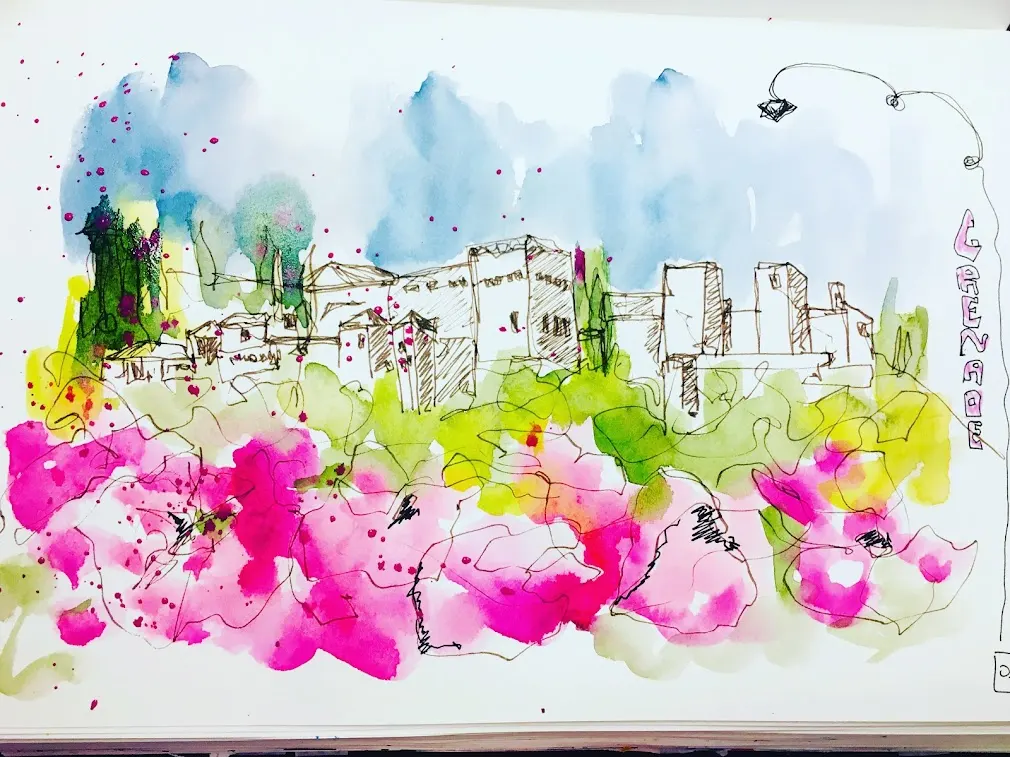
With the holidays approaching, travel watercolor kits are multiplying online, and all promise to be ready for painting outdoors. But are they really useful in the field? An all-in-one kit is neither good nor bad: it is useful when each element meets a real need. In this article, you will learn to read a product page with a 5-element sorting grid, to choose between buying, adjusting or building your own depending on your profile, and to test your kit in 15 minutes.
Why So Many Travel Watercolor Kits This Winter?
With the holidays approaching, travel watercolor kits are multiplying online. Sketchbook, palette, water brush, case: everything seems ready for painting outdoors. Before choosing your travel sketchbook supplies, one question is worth asking: will this kit really be useful in the field?
This article starts from the all-in-one kit and puts it under scrutiny. You will learn how to read a product page and how to choose between buying, adjusting or building your own. You will leave with the list for a minimal kit that fits in a bag.
What Today's Travel Kits Contain
Product pages look very much alike. One kit sold online, on pre-order with shipping announced for 25 November 2026 at the latest, includes for example an A5 landscape watercolor sketchbook, a 24-color palette and a water brush. It also comes with fine pencils and pens, a microfiber cloth, a clip and a canvas case (see the product page).
You almost always find the same items:
- a sketchbook, sometimes refillable, often A5 or smaller;
- a built-in palette, with half pans or solid pastilles;
- one or two water brushes, whose handle holds the water;
- a water reservoir or a small collapsible cup;
- a case that holds everything together.
On paper, nothing is missing. But a kit is designed to cover every situation. On location, you will only use part of it.
The Sorting Grid for Travel Sketchbook Supplies: 5 Elements
For each element, ask yourself three questions. What is it for when I sketch outdoors? Where is its weak point? What should I check on the product page before buying?
1. The Sketchbook Paper
It is the paper that receives the water. Paper that is too thin buckles, soaks up washes and quickly discourages you. This is often where a budget kit makes compromises.
Check the weight first. Aim for at least 200 to 300 gsm for watercolor. The artist Marc Taro Holmes lists a 140 lb cold-pressed watercolor paper, or about 300 gsm (materials list).
Some sketchbooks go much higher. The manufacturer Hahnemühle presents a spiral-bound travel sketchbook in 400 gsm, with 15 sheets, in 15.3 x 25 cm or 19 x 20 cm (manufacturer page). This figure gives a good benchmark for judging the sketchbook in a kit.
A useful nuance: if you mostly draw with a pen, simpler paper may be enough. The sketcher Chris Wilson advises choosing the sketchbook according to what you will really use (his annotated kit). For your bag, prefer A5 or A6.
A refillable sketchbook is only worthwhile if the refills are real watercolor paper. Read their weight carefully, not just that of the original sketchbook. A dedicated article on choosing a sketchbook will complete this point.
2. The Palette
Twenty-four colors is a lot for a beginner. You will spend more time choosing than painting. Chris Wilson relies on a yellow, a red and a blue, each in a warm and a cool version, plus an earth color such as burnt sienna (source).
What to check on the product page:
- removable half pans or glued-in pastilles: only the former can be replaced;
- student grade or artist grade: student grade is enough to try things out, artist grade gives more vivid colors;
- refillable palette: it saves you from carrying tubes, and you keep only the colors you actually use.
3. The Water Brush
It lets you paint without a water jar. This is valuable in town, on a train or in a museum, where you can't spill anything. This case is detailed in our method for sketching in the museum.
Its limits are well known. The flow is hard to control at first, and the tip wears out. Practice squeezing the handle very gently on a scrap sheet before touching your sketchbook.
Chris Wilson keeps the water brush for painting standing up or in a tight space. He takes a classic round brush when he settles in for longer, for more control. No need to buy several: Marc Taro Holmes advises using the largest brush possible for the area to be covered.
4. Water and Cloths
For a short session, the water brush and a cloth are enough. A paper tissue also does the job of wringing out the tip and absorbing excess water.
If you stay seated in one spot, add a small closed bottle. Marc Taro Holmes packs two small containers with lids, paper towels and a spray bottle for his set-up sessions. Think about the dirty water: bring it back in a stoppered bottle rather than pouring it out just anywhere.
5. The Line
Check that your kit includes a pen, and what type. Yet the combination of ink and watercolor gives a travel sketch an enormous amount of structure. The line sets down the shapes, the wash brings the light.
The ink must be water-resistant. Otherwise, the wet brush dissolves the line and everything bleeds. Chris Wilson sums it up this way: if he had to reduce his kit to a sketchbook and a single tool, he would take a pen.
Test it at home. Draw a few lines, wait a minute, then run a wet brush over them. If the line stays crisp, the pen can go on the trip.
Three Profiles, Three Answers
The Beginner Who Wants to Try
A kit can be enough to get you started. It saves you from hunting for each element separately. Replace the sketchbook first if the paper is too thin, then add a water-resistant ink pen if the kit doesn't include one.
The Traveler Who Walks a Lot
Lighten up as much as possible. A palette of 6 to 8 colors, a water brush, a pen and an A6 sketchbook fit in a pocket. This pocket kit is shown in action in our article on travel sketching in the train station.
The One Who Wants to Give a Gift
A gift kit often ends up in a cupboard when the paper disappoints. Look first at the sketchbook's weight, then at whether the pans can be replaced. A refillable palette will stay with the person well after the holidays.
You can also put the gift together yourself. Our page travel sketchbook supplies and sketchbooks gathers ideas for completing a kit.
The Minimal Kit: Final Checklist
Everything must fit in a pouch or a bag pocket. If an item isn't used during three outings, remove it.
- An A5 or A6 sketchbook, paper of at least 200 gsm
- A small palette of 6 to 8 colors, in replaceable half pans
- A water brush
- A pen or felt-tip with water-resistant ink
- A cloth or a few tissues
- A small closed bottle, only for seated sessions
- A soft pouch that slips into your bag
For bulk and weight, keep it simple. Put the filled pouch on a kitchen scale and write the figure on the first page of the sketchbook. Then check that it fits in the pocket of your usual bag.
Test Your Kit in 15 Minutes
Settle at a café terrace or at your window. Choose a simple subject: a table, a façade, a tree.
- An ink line (5 minutes): draw the main shapes, without a pencil.
- Two washes (5 minutes): a light wash for the sky or background, another for the main shadow.
- A spot of dominant color (5 minutes): lay down a single bold color where the eye should go.
Then look at the result. Did the paper buckle? Did the line bleed? Did you miss a color? Your answers tell you exactly what to keep or replace.
The Best Supplies Are the Ones You Have With You
An all-in-one kit is neither good nor bad. It becomes useful when each element meets a real need, and not a theoretical possibility. Keep little, test often, replace whatever slows you down.
To see what sketchbooks painted on location in ink and watercolor look like, browse the books by Isabelle Santori: Palette Marocaine, INDEscriptible and L'Infusion Bleue. Slipped in with a kit, they also make a lovely gift idea.
Isabelle Santori, a painter based in Sigean, in the Aude, also gives travel sketchbook classes and workshops, in two-hour sessions in the studio or outdoors. Dates are available on request by e-mail. A chance to put your travel sketchbook supplies to the test, with guidance.
Key points
| Section | Key messages |
|---|---|
| Today's kits | Sketchbook, built-in palette, water brush, water reservoir and case: complete on paper, but designed for every situation. |
| Sketchbook paper | Aim for at least 200 to 300 gsm, A5 or A6 size. A refillable sketchbook is only as good as the paper in its refills. |
| Palette | 24 colors is too many for a beginner. Yellow, red, blue in warm and cool, plus an earth color. Prefer replaceable half pans. |
| Water brush | Ideal in town, on the train, in the museum. Flow takes getting used to, tip is fragile. A round brush for long sessions. |
| Water and cloths | A cloth is enough for a short session. Small closed bottle if you settle in. Bring the dirty water back. |
| The line | Often missing from kits. A water-resistant ink pen is essential for line and wash. Test it before leaving. |
| Three profiles | Beginner: kit, then change the sketchbook. Walker: ultra-light A6 kit. Gift: check the paper and the refillable palette. |
| Checklist and test | Seven items in a pouch, weighed on a kitchen scale. 15-minute test: line, two washes, one dominant color. |